
How We See?
Beyond First Impressions

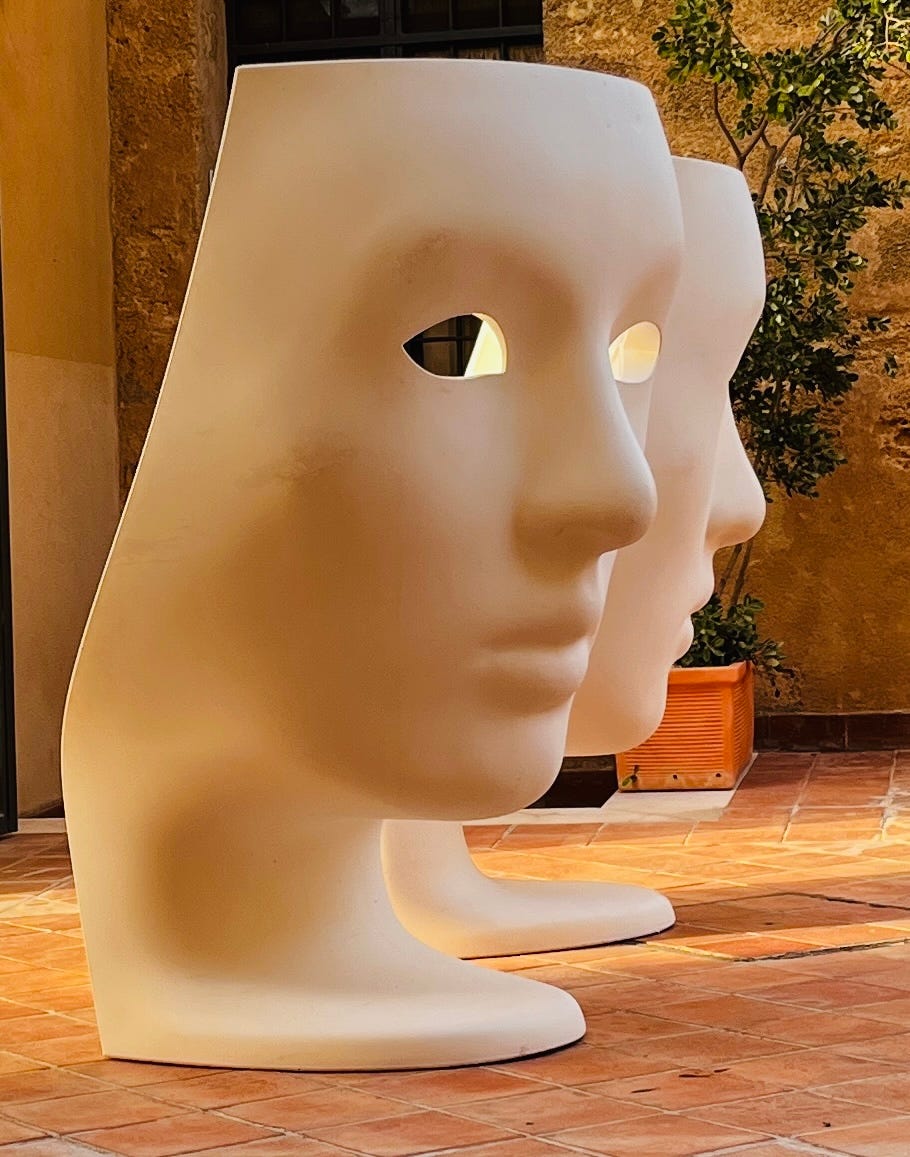
As a seeker and something of an existentialist, I like to explore what captivates me and find meaning in it—which comes naturally with art. When I look at a painting, photograph, or sculpture, I see more than the work itself. Art is a reflection of our desires, interests, and even our goals. It often mirrors back what we choose to see.
“The simple act of observing art without judgment and seeing what emerges becomes an excellent prompt for personal insight. Art in this way becomes a vehicle for curiosity and, ultimately, discovery about ourselves and the world.” - Magsamen & Ross (Your Brain on Art)
My paternal roots run deep with artists, sparking an early interest in making and studying art. Working as a gallerist and curator took my education further, teaching me the value of art—a complex topic worthy of its own exploration. It also taught me the importance of asking questions to discover the deeper story behind the artist, and to confront my initial or inherited beliefs.
What if we apply this same approach to people?
More Than Meets the Eye
I know how it feels to be judged by appearances.
Years ago, before I worked in the arts, my partner at the time and I attended an engagement party for one of his law firm colleagues. While he mingled with legal peers, I sat at the bar in my black lace top and pencil skirt, feeling sophisticated and confident. An older lawyer in an expensive steel grey suit—Canali, he made sure to mention—struck up a conversation, asking about my job, and my views on marriage and children.
Then came his verdict.
"I know your type," he said, leaning close. "You don't belong here. You're not one of us."
He walked away, leaving me staring into my wineglass with shaking hands. In the bar mirror, I questioned everything—my outfit, my job, my worth. He saw a childless shop girl with no formal education—not the autodidactic creative I was.
The pain of being reduced to a "type" based on surface judgments stayed with me for years and became an invaluable lesson: never judge someone based on their education or profession. It also showed me that sometimes the people who look "respectable" can be the cruelest judges.
But I was about to discover I still had blind spots—and a recent trip to Spain offered a reminder.
The Stories Written in Ink
After leaving an artist residency early due to millipede mayhem (New here? Catch Up: Escape from La Gomera), I found myself in San Andrés, a small village on Tenerife's northern tip. My bus journey there took me along miles of paved highway—the last 30 minutes coasting past industrial wasteland, shipyards, and military bases. Instead of vistas of endless sea, abundant on La Gomera, large tankers dotted the waterscape. Where the hell am I? I wondered.
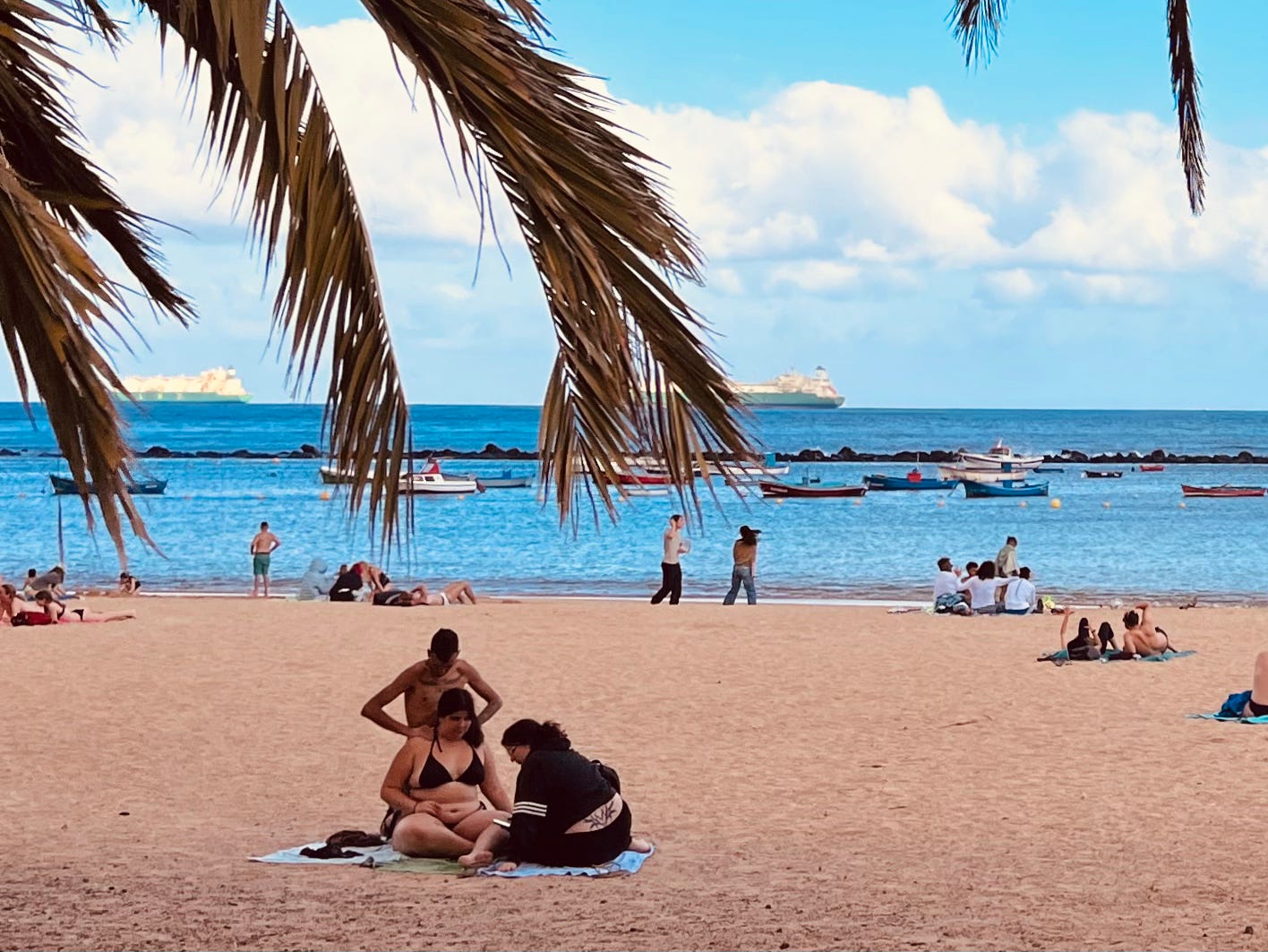
San Andrés assaulted my senses at first: alley cats meowing all night, a 4:30 AM protest complete with firecrackers and angry shouting, babies crying, motorbikes growling, and church bells ringing as frequently as the Islamic call to prayer.
Walking through the village, there were Easter processions with Christ on the cross, priests, altar boys and girls, and clouds of frankincense. On the seawall, at least 20 rocks were painted with faces and names of famous artists and playwrights—all men. The village had an old-school vibe.
But what struck me most was the proliferation of tattoos—especially on the neck. Everyone seemed to have one. Only the babies were ink–free. My snap judgment? These markings reminded me of gang tattoos. Some people looked rough. Dangerous, even.
But after several days, no one harassed me. The only interactions were greetings of “Hola!” and “Buenos Dias” at grocery stores and from a man in his late 70s with lively eyes who said "Tranquilo" (‘calm,’ in Spanish) as I hurried past with my long-legged stride. A recognizable walk that didn’t get me anywhere in my short stint as a model. I walk like an elephant, according to my family.
So why were so many people tatted up? I couldn't stop thinking about it. But the real question wasn't about them—it was about my perception.
Part of living an existential life means confronting your own contradictions. If I hated being judged for my appearance, what did it say about me that I was doing the exact same thing to strangers?
Needing more information, but lacking the Spanish to ask the tattooed locals directly, I asked the owner of my Airbnb why tattoos were so popular.
Her response fascinated me: "The people of the Canaries are descended from the Guanche tribes (Indigenous first inhabitants). Maybe these tattoos are a tradition. Markings done in the past and being reclaimed."
This got me thinking about the Māori and their tattoos as rites of passage—what I'd initially read as threatening might be deeply cultural, even sacred. Perhaps my assumptions weren't just wrong; they were missing entire layers of meaning and history.
Poetic Instincts
But I wasn't done learning about the nuances of judging by appearances.
In early 2020, just before the world changed, I tried Bumble. After weeding through countless inappropriate messages (seriously, Bumble isn't Tinder!), I connected with two intriguing men: a scientist and a philosopher. My initial impressions were captured in this poem:
Bumble

I just wanted to feel
and maybe get felt up.
I just wanted something new
a man that gives a fuck.

Write a bio,
take a photo.
Place an ad
and set your pace.
Get your bait
and toss your line.
Patience wins the race.

I guess I’m good at fishing,
got two men on the line.
A scientist and a philosopher,
but the latter dislikes wine. Pity.

Set a date
go for dinner.
Ask questions,
don’t go too fast.
Get your tests
and share results.
We all have a past.

What to do
now there are two?
I’m not into multiplicity
and certainly not duplicity.
Decisions must be made
before anyone gets laid.

Tell the truth
paint a picture.
With your words
and not your bod.
In time you’ll know
how low to go
or if your Saint
is the Marquis de Sade.
At the time, I had no idea I was channelling my inner oracle.
Plot Twist: People Are Complicated
When COVID lockdowns hit and people retreated into their "bubbles," geography chose for me. The scientist lived across the water in another city—suddenly unreachable. The philosopher was a twenty-minute bike ride away.
It took a while to discover that the philosopher was no Saint. Like the Marquis de Sade, he had a fondness for testing boundaries, and challenging traditional ethics and societal norms. His intellectual identity was so central to who he was that he had it tattooed in Japanese kanji on the back of his neck.
When that relationship ended, I couldn't shake my curiosity about the road not taken. The scientist’s photo was still on my phone—not out of sentimentality, but because it showed exactly what had caught my attention: a fit guy in rugby gear. Coming from a rugby family myself, I recognized something familiar in that image—shared values around fitness, team sports, a certain approach to life. Had my poetic intuition been right about him too?
With San Andrés fresh in my mind and new questions about perception, I reached out to him. It turned out he'd recently thought of me too. With lockdowns lifted and mutual curiosity piqued, we agreed to meet for coffee.
The scientist was as attractive as his photo, open and frank in conversation. But what surprised me most was discovering that much like myself—he shared an interest in reimagining what contemporary relationships could be. We connected on the idea that intimate relationships are up for interpretation, as long as the rules of engagement are discussed upfront.
Meeting the scientist brought clarity: I'd found an awesome new friend, nothing more. But the real revelation? The scientist wasn’t the Saint nor was he the Marquis.
Sometimes people surprise us not by being different from their surface presentation, but by being more complex than any first impression could capture.
The Deeper Story
I've been on both sides now—harshly judged for my job and appearance, while receiving only kindness from tattooed strangers I initially feared.
The stories we carry can't be read on our skin, in our clothes, our degrees, or our bank accounts. We all carry narratives that can't be deciphered from the surface. The question isn't whether we'll make assumptions—we will. It's whether we'll have the courage to look deeper and the wisdom to know we might be completely wrong.
Or occasionally, right.
As a mentor once told me, “It's not what you see Jennifer, it's how you see it.”
The lesson isn't to abandon our instincts but to hold them lightly—trusting our gut while staying open to being surprised. With art, I've discovered that the works that leave a lasting impression aren't always the ones you expect to love. With people, we often read them like books, judging them by their covers. But what if the most interesting stories are the ones we almost didn't pick up?
📚 Further Exploration
📖 Read: "Blink: The Power of Thinking Without Thinking" by Malcolm Gladwell - explores the psychology behind snap decisions and first impressions, including both their accuracy and their pitfalls like prejudice and stereotype.
📖 Read: "Your Brain on Art: How the Arts Transform Us" by Susan Magsamen and Ivy Ross - a deep-dive into neuroaesthetics - the science of how arts measurably change our brains and bodies.
📖 Read: On Looking: Poet Lia Purpura on the Art of Noticing - one of the many great posts from Maria Popova’s The Marginalian.
🎧 Listen: The Therapist Who Breaks All The Rules Terry Real's 45-minute conversation with Tim Ferriss - it just might transform how you see relationships.
🏝️ Catch Up: The Spanish adventure that started it all: Millipede Escape from La Gomera