
Diamonds and Rust
When Mermaids Call, Bring Better Pens: A Greek ODD-yssey | Part III

Editor's Note: Publishing this on the Sunday before Christmas feels appropriate for an essay about nostalgia. The Greek word νόστος (nóstos) means "homecoming," and ἄλγος (álgos) means "pain." Nostalgia is literally the pain of returning home. If the holidays have you wondering why 'going home' feels complicated—welcome to the club. (℞ 🎥 Four Christmases)
Diamonds and Rust
The cats had scattered, the stilettos stayed abandoned, and the dismissive gallery owner’s behaviour still irked me. But the feeling of being moved to tears by art that connected with my deepest self stayed with me. I needed to sit with it.
I found a restaurant nearby on my phone and started walking. That’s when I noticed a man ahead of me, grey-haired, moving with purpose through the narrow streets. Same direction.
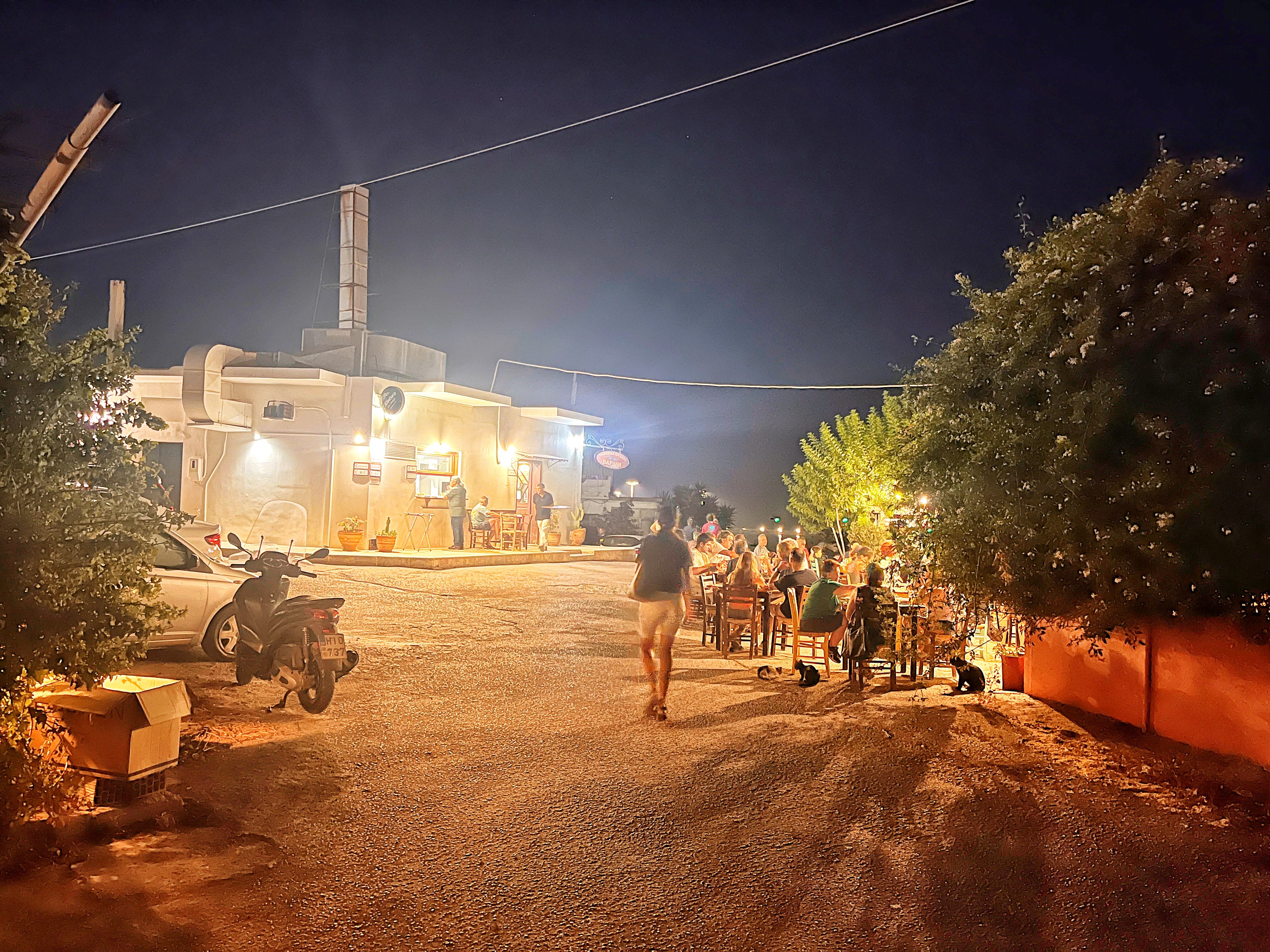
We arrived at Vardis Taverna at the same time. A place where the locals hung out. Tucked away in a humble neighbourhood outside Heraklion’s old city walls, with a view that caught the evening light.
The server greeted him warmly: “Kalispera, Martin!”
Martin, seventy-two years old, I’d learn. British, well-travelled, alone.
“Mind if we sit together?” I asked. “I’m on my own, too.”
And then—because this is how it happens when you’re open to it—we started talking. Really talking.
We each ordered our own drinks, our own food. No performative sharing. No phones on the table. Just two people who’d found themselves in Crete for different reasons, discovering they spoke the same language.
I ordered grilled halloumi rolled in aubergines with roasted tomato sauce—simple, perfect Greek food. The kind I’d wanted on my first night.
We talked about music—Radiohead to Zeppelin, Muddy Waters to the Stones. Concerts we’d loved—he still had tinnitus from a Judas Priest show decades ago. Books we couldn’t put down, sci-fi to high fantasy, world-building and mythology, and our preference for British television.
“Don’t get me started on Dr. Who!” I joked. But I meant it. The Doctor—travelling through time and space, using social intelligence and curiosity to understand different worlds, creating harmony through observation and empathy rather than force.
The conversation flowed—unguarded, one idea pollinating another.
At some point, Martin mentioned he was a former dive instructor—and that he had a glass eye, which I hadn’t noticed. He lost it as a child when a friend tossed a toy airplane with a metal tip high in the air. He watched it arc through the sky, following it with his eyes until it flew straight into one of them.
“I thought about getting an eye made with a smiley face,” he said with a laugh.
Now THAT I would have noticed.
He’d spent years diving in the Middle East. Egypt, the Red Sea.
“Have you ever been to Sharm El Sheikh?” I asked, eyes lighting up.
“Yes—incredible diving there.”
“My ex is a diver. Mostly tropical destinations, but the Red Sea is on his list. I’ve always wanted to go to Egypt…”
Something in the way I trailed off must have registered. Martin shifted gears.
“I travelled too much,” he said quietly. “For my marriage. I realize that now.”
He asked about the writing retreat. I told him about the disconnect—how it was only day two, and I’d barely met the other writers, yet I already felt like an outlier.
“Gets me thinking about this movie I saw a few years ago, The Wall,” he said.
I pulled out my notebook and wrote it down.
Before we said goodnight, Martin leaned forward with the intensity of someone sharing a secret.
"There's also a song you need to listen to—'Diamonds and Rust.'" The original by Joan Baez—not the Judas Priest version.” He paused, his one eye held my two.
I promised.
Walking back through the maze-like streets, I realized I’d missed entirely the official writers’ dinner.
Under the evening sky, I pulled up “Diamonds and Rust” on my phone.
Baez’s voice filled my ears—crystalline, aching, honest. A song about a phone call from an old lover. About nostalgia disguised as casual conversation. About a man who was good with words and skilled at keeping things vague.
I stopped walking.
How many times had I been here before?
Drawn to brilliant men. Artists, writers, musicians. Men whose words made me feel seen and whose silence made me disappear. Men who dismissed my creative work while I championed theirs.
“My poetry was lousy, you said.”
Men who kept things vague because vague meant they never had to commit, never had to fully show up.
But I kept things vague, too. The one who left before real commitment. Maybe I am as afraid of being fully known.
Years ago, I’d written about this pattern, at a different retreat, in a different country:
But just like a song, there is a beginning and an end, unless you hit repeat, as I often do.
Three is my backbeat - the number of times I give myself to a lover. By the third play, the song is no longer new, its words rote memory and the beat...well, it’s any old street.
I read somewhere about highly sensitive people and their subset—the sensation seekers. My dislike of labels didn’t stop me from reading to try and understand my pattern of three. I wonder if it’s the men or the hunter in me?
I get high on the rhythm when I dance to the beat. My feet only still while I’m feeling the heat. When the bed turns cold I head for the door. But don’t worry darling, I’ll be back...two times more.
Three times. Three years max. That’s how long I give.
My last relationship—the third time with the same man—the one who used an octopus emoji instead of his name. Who kept everything vague, slippery. Who vanished into darkness whenever I saw him clearly.
Joan Baez singing about diamonds turning to rust. The way we hold onto what we should let go.
How had Martin known?
I WAS nostalgic. For the dance parties, a pure form of somatic expression, and conversations with substance. The good parts of my last relationship were real. The poison was, too.
And I’d flown to Greece to escape it.
Back at the hotel, I opened my journal.
How we women suffer with men—and I am sure men suffer with me too.
You can’t transform what you won’t name.
I thought about The Wall—the movie Martin had mentioned. A woman cut off from all human contact by an invisible barrier. But there was another wall in this story. The one I kept building around my heart in year three. The pain of returning home to the same wound, over and over.
“Stay open. If your defences come up, you’re fucked,” I wrote to my ex once.
Maybe I needed to take my own advice.
Tomorrow I’d pile into a minibus with the other writers, heading south to the retreat location. And in a couple of days, I had a Zoom call with a psychic who helps me read signs in the spirit world, where I’m far more comfortable than the material one.
I’d booked her for a past life reading—maybe I’d been a priestess in a Greek temple, or a scribe who’d angered the gods.
Surely my patterns had mythological origins.
Next in this series: Part IV: When the Psychic Can't Read You (Because Goddesses Want Direct Access)
Previous in this series: Art Speaks When Humans Won’t
📚Resources & Further Exploration
🎵Listen: “Diamonds and Rust” by Joan Baez - The original 1975 recording about her relationship with Bob Dylan.
🎧 Listen: We Can Do Hard Things with Glennon Doyle - “Elizabeth Gilbert on Losing the Love of Her Life” (September 2025) - About intimacy, betrayal, codependency, and recovery.
🎥 Watch: The Wall (2012) - Austrian-German film about a writer cut off from humanity by an invisible barrier.
Diamonds and Rust, up until a couple months ago… never heard of the song… now referenced twice. I’m really enjoying your writing Jennifer!
Love this piece JJ. I’ve never heard of the song, just listened to it and found it haunting, gave me goosebumps. Made me think of an ex who trailed me for ten years, lives in Zambia with rare visits to the Uk, kept his words vague, kept me waiting. Some years ago, consumed with unresolved grief for the marriage I had ended 15 years earlier, before I had a breakdown, I realised that I attracted the available men because in reality I was unavailable too - it’s how I kept myself safe from hurt.